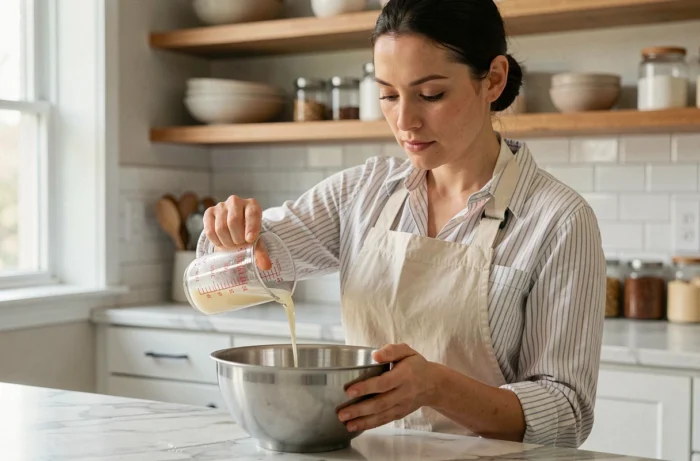
Pour 80 ml de crème liquide versés dans un measuring jug graduated in 25 ml increments, the level falls exactly between two markings. The result: you hesitate, round it off, and the ganache goes wrong. Converting 80 ml to cl takes just one division, but the real challenge begins when your kitchen equipment isn’t up to the task.
Measuring 80 ml without the right markings: the real kitchen challenge
The rule is simple: 80 ml is exactly 8 cl. Divide the number of millilitres by 10, and you’re done. Temperature, density and ingredients don’t come into it, since this is a volume conversion.
The problem comes after the calculation. A standard measuring jug has markings every 25 ml. To measure 80 ml, you need to aim for a level between the 75 ml and 100 ml marks—four-fifths of the way along that interval. Estimating this position by eye can lead to inaccuracies that affect a baking recipe.
To read a liquid correctly in a graduated container, place the jug flat on the worktop and position your eyes level with the liquid’s surface. With liquids that wet the sides of the container (water, milk, cream), the surface forms a concave meniscus: always read the bottom of the meniscus, not the edges that curve up against the glass. Looking down or from an angle will consistently give you an inaccurate reading.
The shape of the container can magnify the error. In a straight-sided glass with an inside diameter of about 8 cm, a height difference of just one millimetre represents roughly 5 ml of liquid. For an 80 ml measure, that 5 ml difference can noticeably change the proportion of an ingredient in a vinaigrette, caramel or pancake batter.
So, when you convert 80 ml to cl, the answer is 8 cl—but the final accuracy depends above all on how you physically measure that volume.
Scales or measuring jug: choosing the right tool for each ingredient
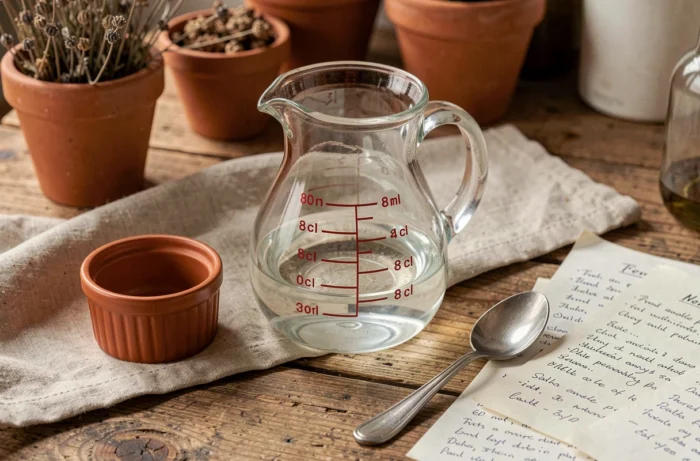
Converting millilitres to centilitres is about volume. It tells you nothing about weight. Pour 80 ml of water onto a scale and it will weigh about 80 g, because water has a density close to 1. The same volume of olive oil weighs less. Honey weighs considerably more.
For thin liquids (water, milk, vinegar, lemon juice), a measuring jug is still the quickest tool. Aim for 8 cl or 80 ml, depending on the markings, and the margin of error will be acceptable as long as you read the meniscus at eye level.
For thick or viscous ingredients, scales are the better choice. Honey, thick cream, tomato purée and maple syrup cling to the sides of the container. Some of the measured volume remains stuck to the jug after pouring, so the amount that actually makes it into the mixture is less than what you measured. Weighing directly into the mixing bowl (after taring the scales to zero) avoids this loss.
When scales are a better choice than measuring by volume
- Honey, agave syrup, molasses: their viscosity leaves a thick coating on the sides of the measuring jug, making the transferred amount several millilitres less than measured.
- Thick cream, mascarpone, fruit purées: their consistency makes it difficult to read the level in a measuring jug, as the surface doesn’t form a clear meniscus.
- Oil in a precise baking recipe: oil has a different density from water, so 80 ml of oil doesn’t weigh 80 g. If the recipe gives a weight, use that.
The rule of thumb is simple: measure free-flowing liquids by volume. If an ingredient sticks to the container or the recipe gives a weight, weigh it.
Useful volume conversions for cooking with 80 ml
Knowing that 80 ml equals 8 cl is a good starting point. In the kitchen, you’re constantly switching between millilitres, centilitres, spoons and cups. Here are some handy equivalents for this measurement.
| Measure | Equivalent |
|---|---|
| 80 ml | 8 cl |
| 80 ml | 0.08 litres |
| 1 tablespoon | about 15 ml (1.5 cl) |
| 1 teaspoon | about 5 ml (0.5 cl) |
| 5 tablespoons + 1 teaspoon | about 80 ml |
The last line in the table is the most useful for everyday cooking. If you don’t have a finely graduated measuring jug or scales, five tablespoons and one teaspoon will give you very close to 80 ml. This works well for thin liquids, but less well for thick mixtures that don’t fill a spoon evenly.
Adapting the conversion for recipes from the US and UK
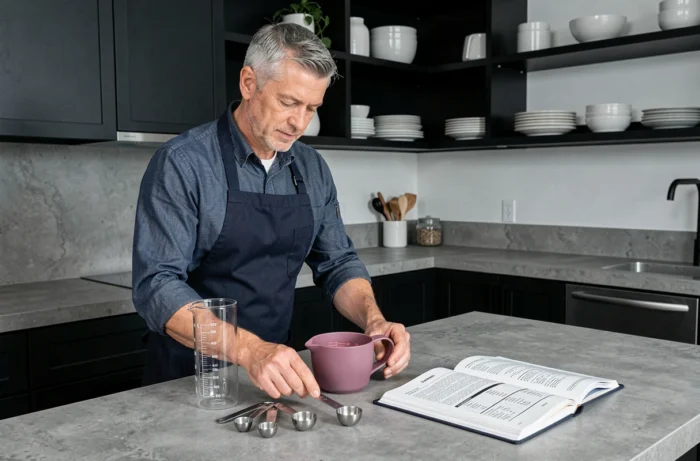
English-language recipes often use the “cup” as a unit of measurement. A standard US cup holds about 240 ml. To measure 80 ml, fill one-third of the cup. It isn’t exact to the millilitre, but for everyday cooking, the difference is negligible in most savoury dishes.
For baking, where precision matters more, use scales or a metric measuring jug rather than trying to measure a fraction of a cup.
Common mistakes when converting millilitres to centilitres
Dividing by 10 seems too simple to get wrong. Yet mistakes do happen, especially when you’re working with several units in the same recipe.
The most common mix-up is with the decilitre. One decilitre is 100 ml (10 cl), not 10 ml. Mistaking “dl” for “cl” when reading quickly can make you multiply or divide the amount by 10. For 80 ml, confusing 8 cl with 8 dl means pouring in ten times too much liquid.
The other pitfall is converting volume to weight. Converting 80 ml to 8 cl is a conversion between units of volume. Converting 80 ml to grams requires knowing the ingredient’s density, and that density varies from one product to another. Automatically assuming “80 ml = 80 g” works for water, but not for oil or honey.
One last thing to bear in mind: kitchen spoons aren’t standardised to industrial levels of precision. Two tablespoons from different brands may hold slightly different amounts. The difference in a single spoonful is negligible. But over five spoonfuls to reach 80 ml, it can add up to a few millilitres—enough to change the texture of a cream or emulsified sauce.
Converting 80 ml to cl comes down to one number: 8 cl. The accuracy of the measurement then depends on choosing the right tool and reading it carefully. A measuring jug placed flat on the worktop, eyes level with the meniscus for thin liquids, and scales for viscous ingredients: these habits matter more than the formula itself.