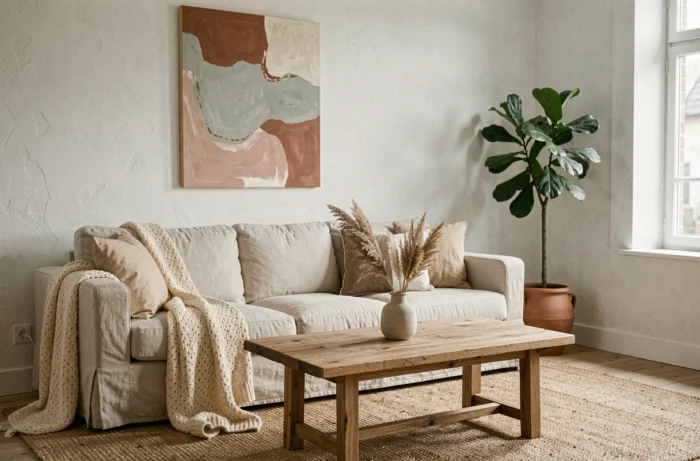
The interior design market in 2026 is no longer just a list of trendy colors or materials. Trade shows themselves are changing format: Maison&Objet has split its editions into two distinct events, Maison&Objet Pulse in September (experimentation, design, hospitality) and Maison&Objet Premier in January (manufacturing know-how). This segmentation reflects a fragmentation of references that makes any linear synthesis of decor trends unreliable.
3D Printing and Biopolymers: When Manufacturing Becomes a Design Choice
Competitors talk a lot about natural materials (wood, linen, stone). However, a phenomenon visible at Maison&Objet Pulse 2026 deserves equal attention: 3D printing is moving beyond prototyping to become a decorative language. Objects produced on demand, in biopolymers, corn starch, recycled plastic, or reed fibers, appear at the stands as finished pieces, not as technological curiosities.
The interest for your interior is twofold. First, on-demand production eliminates molds and reduces waste, addressing a sustainability requirement without going through the vintage circuit. Second, the shapes obtained through digital printing do not resemble anything that molding or turning allows: honeycomb textures, layered surfaces, impossible-to-machine geometries.
For those looking to explore decor on Espace Déco, this type of piece offers a concrete starting point to move away from standardized catalogs. The limit remains the unit price, still high for large furniture pieces, and the lack of an established repair network.
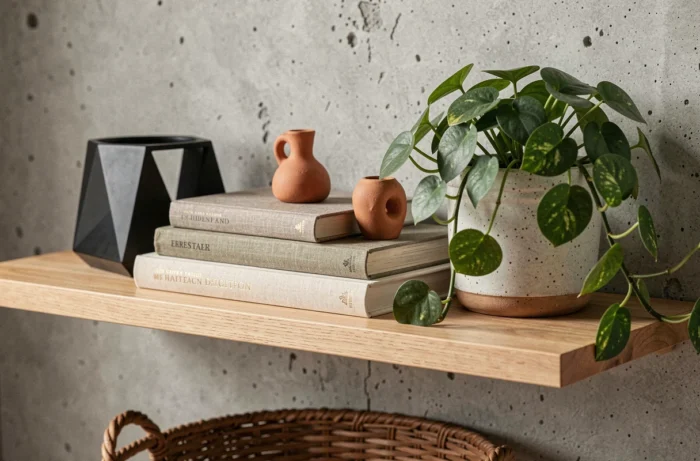
Reuse in Interior Design: A Discourse That Exceeds Reality
Vintage, second-hand furniture, and reclaimed materials occupy a central place in magazines and social media. Competing content all recommends integrating antique pieces into a contemporary interior. The problem is that the share of objects and materials in the home actually oriented towards reuse remains marginal.
This observation puts the prevailing enthusiasm into perspective. Buying a 1960s sideboard or an industrial light fixture remains a relevant individual gesture, but it does not constitute a measurable underlying trend at the market level. The majority of furniture and decor objects sold in France are new, made in traditional circuits.
What Specifically Hinders Reuse in Decor
- The absence of dimensional standards: an antique piece of furniture does not always fit into a space designed for contemporary modular furniture, which imposes costly adaptations.
- The traceability of materials: for old paints, glues, and coatings, current health standards are not always met, and the buyer cannot easily verify this.
- Logistics: transporting a massive second-hand piece of furniture from 200 kilometers away negates part of the ecological benefit compared to a new product delivered from a local warehouse.
This does not disqualify reuse as a source of decor inspiration. However, presenting vintage as the norm for 2026 is more about storytelling than reality.
Color and Texture in 2026: The Trend Shifts Towards Surface Effects
Color palettes remain a recurring topic. Warm tones (burgundy, terracotta, deep brown) already dominated in 2025. What changes in 2026, according to observations from Parisian trade shows, is the shift of attention towards surface effects rather than just hue.
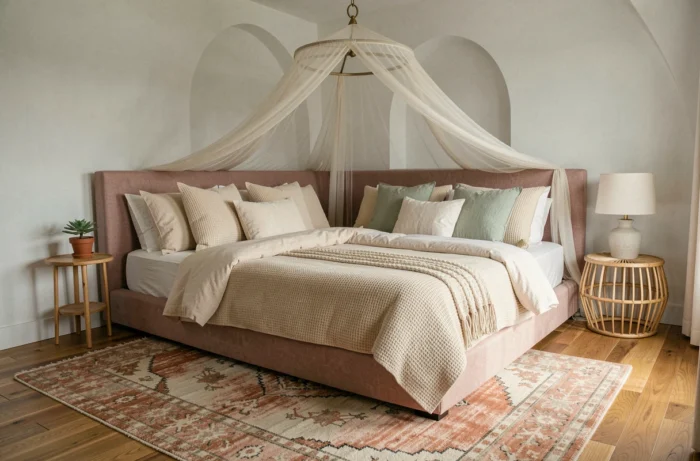
Texture now takes precedence over color in the choice of wall coverings and furniture. Irregular lime-based plasters, brushed wood that reveals the grain, matte ceramics with visible texture: the living room is no longer thought of as a Pantone palette, but as a tactile ensemble.
Lighting and Material Perception in the Living Room
A wall with raw plaster does not produce the same effect under direct lighting as it does under low-angle light. Designers observed at Paris Design Week 2026 treat lighting as a material revealer, not just a functional tool. A spotlight angled 15 degrees from the wall highlights every bump in a plaster finish, while a centered ceiling light flattens it.
For a living room or a living space, this principle has a practical consequence: choosing a textured material without adapting the lighting neutralizes the desired effect. Before investing in decorative plaster or stone cladding, testing the existing light in the room can prevent disappointments.
Maison&Objet Pulse and Premier: What the Split of the Fair Reveals About the Market
The decision by Maison&Objet to separate its two annual editions is not trivial. The Pulse edition (September) targets experimentation: new materials, intersections between design, retail, and hospitality. The Premier edition (January) focuses on craftsmanship and manufacturing production. This distinction reflects a decoration market that no longer operates as a uniform block.
The trends presented in September are not the same as those in January. Printed biopolymers, objects made from local fibers, and hybrid installations between art and furniture belong to Pulse. Solid woods, artisanal ceramics, and handwoven textiles fall under Premier.
A coherent interior in 2026 can draw from both registers, but with the understanding that these objects do not come from the same production ecosystem. Mixing a corn starch printed lamp with a solid walnut table is not incoherent, as long as one understands that their life cycles, prices, and purchasing circuits differ radically.
The gap between the prevailing discourse on reuse and the actual volumes of reused items illustrates the necessity to verify each inspiration before applying it at home. Materials, lighting, surface effects: these concrete parameters, more than the label of a trend, determine the coherence of an interior.