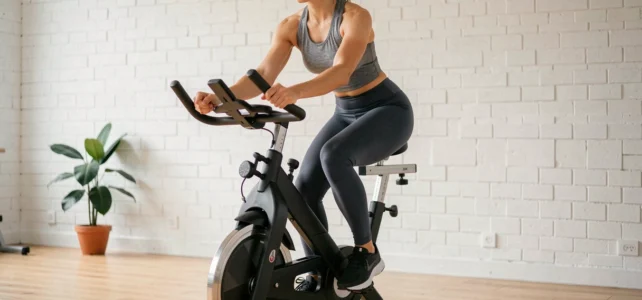
The Sportstech SX200 occupies a special place in the home spinning bike segment. Marketed for several years, this speed bike continues to appear in searches by indoor biking enthusiasts. Its pricing remains attractive, with promotions regularly observed on major marketplaces, which raises a legitimate question: does the SX200 still hold up against updated competition?
Life Cycle of the Sportstech SX200: a Model at the End of the Catalog
Online content still presents the SX200 as a best-seller for the brand. This reading deserves some nuance. Since 2023-2024, several signals indicate that this model is entering a phase of commercial decline.
Stock shortages have become more frequent on direct sales channels. When the product is available, it is more often sold by third-party sellers than by Sportstech itself. Recurring price drops confirm this trend: they reflect less a commercial generosity than an effort to clear remaining stock before a possible withdrawal from the catalog.
For a buyer, this situation has concrete implications. The availability of spare parts (brake pads, saddle, pedals) could decrease in the coming years. Before ordering, checking that the model is shipped by an official seller or an authorized dealer remains a useful precaution, especially for claiming the warranty.
Several users share their reviews of the Sportstech SX200, rightly highlighting these concerns about medium-term after-sales support.
Friction Resistance and Inertia Wheel: What the SX200’s Mechanics Are Worth
The SX200 relies on a belt drive coupled with a friction resistance system. A felt pad presses against the inertia wheel to slow the movement. This technical choice has a direct advantage: quiet operation, often cited as one of the major strengths of this bike.
The inertia wheel has a substantial weight that ensures smooth pedaling. The effort sensation is closer to that of a studio biking bike than a classic exercise bike. Resistance adjustment is done manually via a knob, without electronic increments.
The felt pad wears out faster under intensive use, typically beyond four to five HIIT or studio biking sessions per week. Recent user feedback (2023-2024) reports a rubbing noise after a few months of intensive use.
Maintenance involves lubricating the contact area between the pad and the wheel, or even replacing the pad. This is a simple operation but one that should be anticipated, as short tests do not always mention this mechanical downside.
Manual or Magnetic Resistance: A Structuring Difference
Magnetic resistance spinning bikes, more common in recent models, do not have a wear part in contact with the wheel. Their braking occurs without physical friction, eliminating the wear issue of the pad. However, the acquisition cost is generally higher.
The SX200 remains relevant for regular but moderate use, around three sessions per week. For very intense daily training, the durability of wear parts becomes a real deciding factor.
Comfort and Adjustments of the SX200: The Limits of Prolonged Use
The handlebars and saddle are adjustable in height and depth. This range of adjustment allows the bike to be adapted to various body types, with a maximum user weight announced at 125 kg. The pedals accept cycling shoes with cleats, which is appreciated by regular biking practitioners.
The saddle, however, concentrates a significant share of the criticism. In the first weeks, comfort seems acceptable. After several months, user feedback diverges on this point: some users report a saddle that compresses and loses cushioning, particularly during long sessions of over 45 minutes.
- The original saddle can be replaced with a standard road bike model, provided the compatibility of the mounting bracket is checked
- Mixed pedals (flat on one side, cleats on the other) are a real plus for alternating between regular sports shoes and cycling shoes
- The multiposition handlebars allow for varied postures (hands high, low, in racing grip), a feature that entry-level exercise bikes do not offer
Console and Connectivity of the Sportstech SX200 Bike
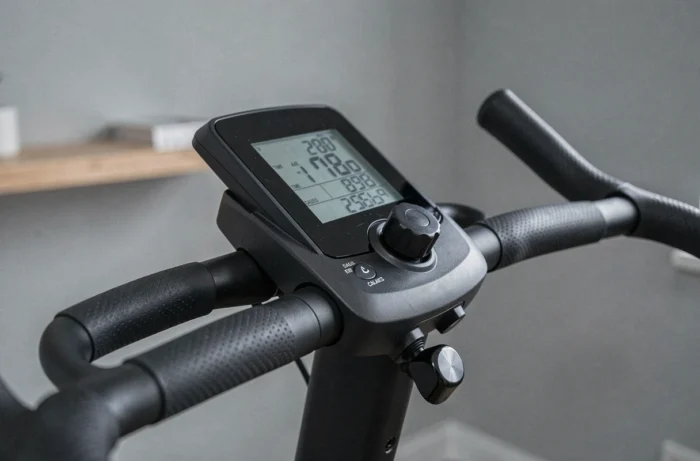
The console screen displays basic data: speed, distance, duration, estimated calories, and heart rate via the pulse sensors integrated into the handlebars. Compatibility with the Kinomap app via Bluetooth allows users to follow video routes and record their performance.
This connectivity works, but it lags behind current market standards. More recent connected biking bikes feature larger touch screens, multi-application compatibility (Zwift, Kinomap, iFit), and sometimes automatic resistance adjustment based on the route. The SX200, with its manual adjustment and compact screen, belongs to an earlier generation of connectivity.
For a user who is content to track basic statistics and pedal independently, the console fulfills its role. For those seeking an immersive experience driven by an app, other models today offer more advanced integration.
Should You Still Buy the Sportstech SX200 in 2026?
The SX200 remains a mechanically solid spinning bike, with smoother pedaling than most classic exercise bikes in the same price range. Its mechanical base, silence, and multiple adjustments make it a credible device for regular cardio training at home.
The reservations concern the durability of wear parts in case of intensive use, dated connectivity, and uncertainty regarding the future availability of the model and its accessories. If the displayed price includes a significant discount compared to the initial price, the quality-price ratio can remain interesting. However, the purchase implies accepting that it is a product at the end of its cycle, with the limitations that this entails for long-term support.