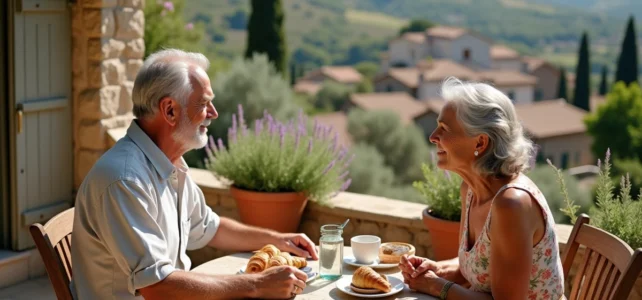
The south of France refers, in terms of retirement, to a geographical arc that roughly extends from the Atlantic coast (Basque Country, Landes) to Provence-Alpes-Côte d’Azur, passing through Occitanie. This territory shares a common trait: an annual sunshine level significantly higher than the national average, combined with mild winter temperatures. For retirees, this climatic parameter is not a luxury; it is a direct factor of daily comfort and health.
Climate of the South and Senior Health: An Underestimated Link
Climatic comfort is not just about the pleasure of having coffee on a terrace in February. Milder winters reduce the burdens related to heating, seasonal isolation, and the risks of falling on frozen ground. Long, bright days also facilitate maintaining regular physical activity, from walking to hiking.
The Mediterranean regions and the southern Atlantic coast offer a number of sunshine hours per year that far exceed those of northern regions. This difference has a measurable impact on morale and lifestyle, two parameters that matter more after retirement.
Those considering moving south with 123 Net Immo will find useful information on the concrete trade-offs related to this type of project, from choosing the city to the question of the real estate budget.
Cost of Living in Occitanie and the Southwest: Real Differences with the Côte d’Azur
Talking about the “south” as a homogeneous block would be a mistake. The cost of living varies greatly depending on the sub-region. The Côte d’Azur (Nice, Cannes, Antibes) displays real estate prices and daily costs close to those of the Paris region. In contrast, inland Occitanie, Landes, and Gers remain significantly more accessible.
For the same pension, the real purchasing power differs depending on whether one settles in Béziers, Dax, or Menton. Local taxes, price per square meter, and the cost of everyday services create disparities that each future retiree must evaluate before choosing their destination.
Some Geographical Points to Keep in Mind
- The Atlantic Southwest (Basque Country, Béarn, Landes) combines a mild oceanic climate with moderate real estate prices outside popular seaside resorts like Biarritz.
- The Occitanie hinterland (Ariège, Gers, Aude) offers some of the lowest living costs in the south, but with sometimes low medical density.
- Inland Provence (Var, Vaucluse outside the coast) offers a good compromise between Mediterranean sunshine and a controlled budget, provided one avoids the overcrowded tourist areas in summer.
Access to Healthcare in the South of France: The Question That Changes Everything
Sunshine and quality of life are not enough if access to medical facilities is problematic. The density of general practitioners and specialists varies greatly, even within the same region. The major urban areas of the south (Toulouse, Montpellier, Marseille, Bordeaux) have efficient university hospitals and a comprehensive healthcare offering.
On the other hand, some rural areas of the southwest or Mediterranean hinterland experience healthcare supply tensions comparable to those in central France. Before settling, checking the presence of general practitioners accepting new patients, the proximity of a hospital, and access to specialists (cardiology, ophthalmology, rheumatology) is a basic precaution.
An enjoyable living environment does not compensate for a medical desert. This is the criterion that should take precedence in the final decision, before the price per square meter or the weather.

Senior Participatory Housing: An Emerging Alternative in the South
Beyond the classic model (buying a single-family home or entering a service residence), a still marginal but growing option deserves attention: senior participatory housing. The principle is based on a group of retirees who share common spaces while each maintaining a private residence in a self-managed structure.
In Bérat, south of Toulouse, fourteen seniors have lived together for four years in a participatory housing model collectively managed by a tenants’ association. This model offers a friendly environment, less medicalized than a service residence, and meets the social connection needs that many retirees express after a move.
The “Housing Recovery” bill presented on June 24, 2026, explicitly identifies shared housing for seniors as a segment to support. The same law reopens around 700,000 homes classified F or G in the DPE for rental, provided renovation work is undertaken. For renting retirees in the south, this measure could significantly expand the available offer.
Social Connections and Cultural Life: The Invisible Factor of a Successful Retirement
Moving to the south of France after retirement often involves leaving behind a social network built over decades. The local cultural richness, the density of associations, and the ease of creating new connections play a crucial role in the success of this transition.
The medium-sized towns in the south (Pau, Albi, Nîmes, Aix-en-Provence) offer a rich cultural life on a human scale: regular markets, theater seasons, festivals, sports clubs. This ongoing activity facilitates integration much more than an isolated village, no matter how picturesque it may be.
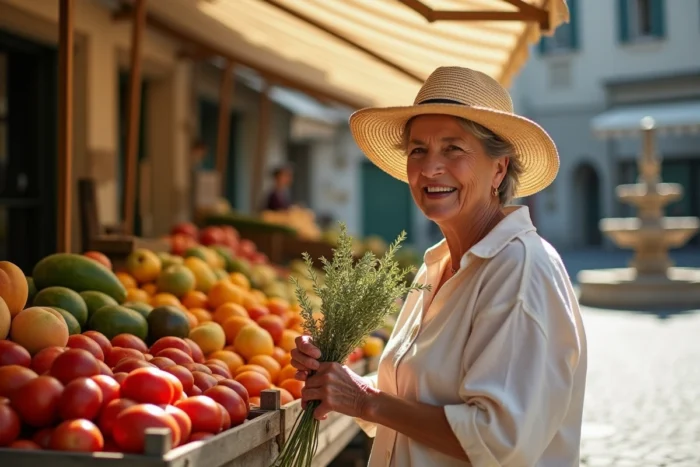
- Outdoor markets, omnipresent in the south, serve as natural socializing places, beyond their commercial function.
- The associative fabric in the municipalities of the southwest and Occitanie remains particularly active, with structures dedicated to seniors (workshops, hikes, cultural activities).
- Participatory housing projects like that of Bérat create a voluntary collective living environment, without the medical dimension of nursing homes.
Choosing the south of France for retirement means weighing several parameters that are not limited to sunshine. Access to healthcare, the real cost of living according to the sub-region, and the ability to recreate social connections weigh as heavily as the weather in daily quality of life. Retirees who successfully make this transition are generally those who have identified their concrete priorities before signing a sales agreement.