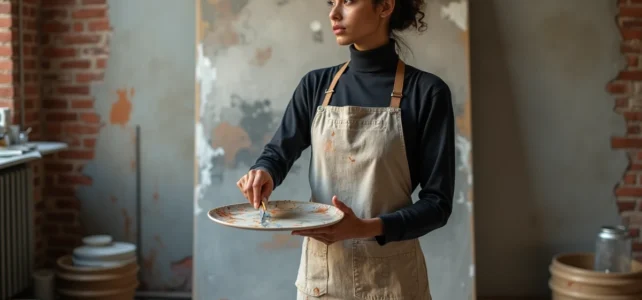
When searching for information about Astrée Lhermitte-Soka, Google results lead to Thierry Lhermitte, his filmography, and the family. This omnipresence of the father in search results makes it difficult to document the painter’s journey, and it is precisely this discretion that makes her trajectory atypical in a field where media visibility often conditions a career.
Training in the United States and early careers of Astrée Lhermitte-Soka
Astrée Lhermitte-Soka, born in 1975, grew up in Paris in a family environment marked by the arts and letters. Her paternal great-grandfather, neurologist Jean Lhermitte, and further back in the family tree, painter Léon Lhermitte, anchor the family in a long-standing intellectual and artistic tradition.
Rather than staying in this Parisian setting, she went to study at the Savannah College of Art and Design in Georgia. This is far from the classic path of French Fine Arts. There, she obtained degrees in graphic design and illustration, two technical disciplines that train both the eye and the hand.
After Savannah, she settled in New York for three years. She worked there as a graphic designer, a job that is both a means of support and formative. This immersion in the American scene, where she simultaneously retouches for herself, details what the journey of Astrée Lhermitte-Soka concretely covers between training, expatriation, and a gradual transition to painting.

Back in France, she shifted towards cinema, not in front of the camera, but behind the scenes. She works as a makeup artist, a set job that requires precision and a fine understanding of textures, colors, and light on a face. This passage through professional makeup is not anecdotal: it directly feeds into her later painting.
Painting of Astrée Lhermitte-Soka: works and style
The transition to painting was not a break but a continuation. Graphic design, illustration, makeup: each step has built a visual vocabulary. When Astrée Lhermitte-Soka begins to exhibit her canvases, she carries with her this accumulation of technical know-how.
Among her identified works, titles such as Doux-soeur, Les robes porte-bonheur, and Hexagone exigu can be found. These titles hint at a work that lies between the intimate and the symbolic, with particular attention to both words and images.
Her approach remains difficult to categorize based on the available public sources. Feedback varies on this point: some describe her as a contemporary figurative painter, while others emphasize the narrative dimension of her canvases. This ambiguity is partly due to her low presence in the traditional media circuits of contemporary art.
Status of artist-author in France: concrete constraints
The regime for artist-authors has been profoundly reorganized in recent years. The collection of social contributions has been transferred to the Urssaf artist-authors, with a generalization of online declaration.
For an artist like Astrée Lhermitte-Soka, this concretely means that:
- Income from the sale of canvases falls under the main regime of artist-authors, with social contributions calculated on non-commercial profit.
- The art courses and workshops she might give are classified as ancillary income, limiting their share in the overall turnover without leaving the regime.
- The distinction between main and ancillary income imposes a precise structuring of the activity, under penalty of requalification by the administration.
This administrative framework directly impacts how a painter organizes her year: number of exhibitions, prices of works, volume of workshops. These constraints are an integral part of the profession, just like studio work.
Relationship with Thierry Lhermitte: asset or hindrance for the career
Being the daughter of an actor as recognized as Thierry Lhermitte produces a paradoxical effect. The name opens doors, attracts the attention of celebrity media, but it also confines. Every article brings her back to her father rather than to her canvases.
Thierry Lhermitte himself has publicly mentioned his children (Astrée, Victor, and Louise) without ever seeking to project them into the media spotlight. Hélène Lhermitte (née Aubert), Astrée’s mother, also remains very discreet. This family discretion is consistent: one does not build artistic credibility on a surname.
The difficulty for Astrée Lhermitte-Soka lies in a concrete problem of referencing and perception. When a gallery owner or collector types her name, they find Gala, Voici, family portraits. The pictorial work takes a back seat in search results. This is a real obstacle for any artist who wants to be judged on her works.
Digital visibility of emerging artists: the case of Lhermitte-Soka
The contemporary art market still largely operates on word-of-mouth, recommendations from gallery owners, and professional networks. For emerging artists, online presence becomes a lever, but it remains poorly mastered by most.
In the case of Astrée Lhermitte-Soka, there is an absence of a personal website dedicated to her work, at least in publicly accessible results. The available information comes from celebrity media or general biographical sites. No online gallery seems to reference her canvases in a structured manner.
This lack of personal digital presence is not uncommon among artists who prioritize the physical circuit (exhibitions, fairs, studio sales). However, it poses a discoverability problem for anyone looking to buy or simply see her work without going through traditional channels.
Her American training, successive transitions, and choice of painting outline a deliberate trajectory. The absence of a dedicated website and the saturation of search results by celebrity media remain the two concrete barriers to the recognition of her pictorial work outside the circle of insiders.