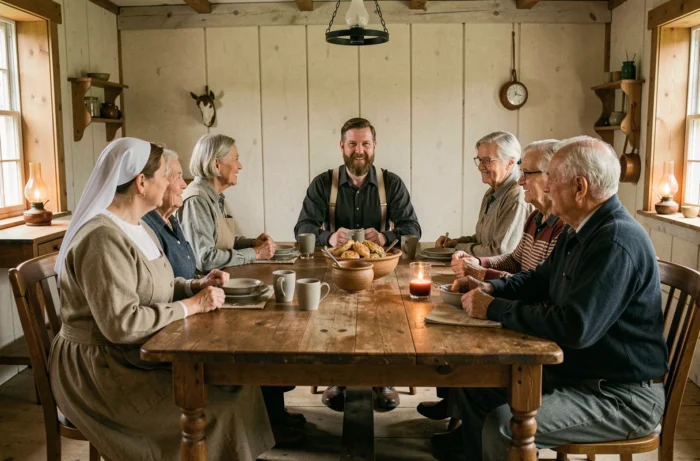
The question regularly arises on forums and in Google searches: do the Amish practice polygamy? This confusion, fueled by amalgamations between American religious communities, persists despite the complete lack of historical or theological foundation. Amish marriage is based on a strictly monogamous model, rooted in a literal reading of the New Testament.
Understanding where this myth comes from involves untangling several threads: the confusion with other groups, the actual functioning of marriage in Amish communities, and the mechanisms that render polygamy structurally incompatible with their way of life.
Confusion between Amish and fundamentalist Mormons: the origin of the myth
The most common misunderstanding can be summed up in one sentence: many people confuse the Amish with the Mormons. Both groups are American, religious, and live in relatively closed communities. The similarities end there.
The Amish descend from the European Anabaptist movement, founded in the 16th century. Their theology is rooted in a rigorous interpretation of Protestant Christianity. The Mormons, on the other hand, belong to the Church of Jesus Christ of Latter-day Saints, founded in the 19th century by Joseph Smith. It is within a dissident branch of this church, the FLDS (Fundamentalist Church of Jesus Christ of Latter-Day Saints), that polygamy has been practiced and documented.
When one inquires about polygamy among the Amish, one actually encounters a subject that pertains to a completely different faith. Mainstream media, by treating American religious communities as a homogeneous block, have contributed to maintaining this confusion for decades.
Amish monogamous marriage: what the Ordnung prescribes
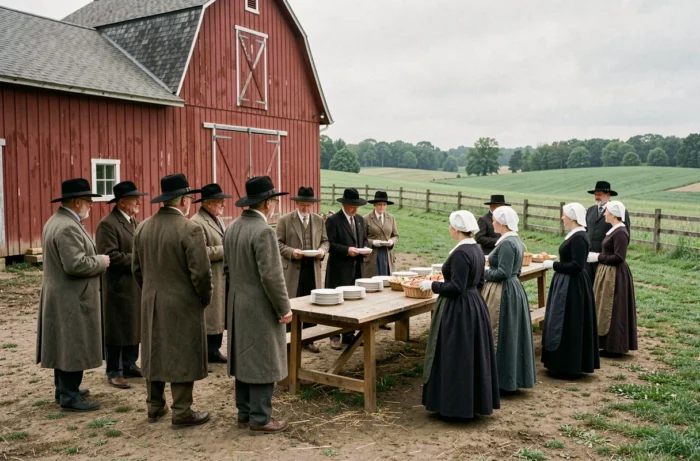
Each Amish community lives according to a set of unwritten rules called the Ordnung. This code governs everything from the type of clothing worn to the relationships between spouses. Marriage occupies a central place, and its form is unambiguous: one man, one woman, for life.
Divorce is prohibited. Remarriage is only possible in the event of a spouse’s death. The ceremony typically takes place at the bride’s parents’ home, in front of the gathered community. The couple does not wear wedding rings, which are considered an ornament contrary to the simplicity (Gelassenheit) advocated by the Amish faith.
A community framework that excludes any marital deviation
The social pressure within an Amish community is considerable. Any failure to adhere to the rules of the Ordnung can lead to Meidung, a form of excommunication and social ostracism. Practicing polygamy would simultaneously violate the religious code, community expectations, and American civil law.
No documented cases of polygamy have been recorded in Amish communities, neither by specialized researchers nor by former members who have left the group. Saloma Miller Furlong, who published a detailed account of her life within the community, does not mention this practice among the issues she raises.
Conversions to the Amish: a flow too weak to import outside practices
One argument sometimes put forward is to imagine that members of polygamous groups could join the Amish and introduce their practices. The available data dismiss this hypothesis.
A study published in 2023 in Population Studies (Cory Anderson and Stephanie Thiehoff) counted conversions to Amish communities over nearly a century. The result is striking: only 154 adults joined the Amish as first-time converts, out of a total population numbering in the hundreds of thousands.
- These 154 individuals represent about 0.146% of baptized Amish members living in 2010, a figure that illustrates the extreme closure of the group to outside influences.
- The profiles of these converts mostly correspond to individuals from traditional Christian backgrounds, not defectors from polygamous groups like the FLDS.
- Integration into an Amish community requires learning the Pennsylvania dialect, fully adopting the local Ordnung, and undergoing a lengthy probationary period, all filters that make any cultural infiltration practically impossible.
This near-zero conversion rate means that the Amish reproduce culturally and demographically in a closed circuit. The likelihood of a practice as radically foreign as polygamy taking root there is, in fact, nil.
Why the myth of Amish polygamy persists online
Google searches related to the Amish regularly mix terms associated with Mormons, Mennonites, and the Amish in the same queries. Suggestion algorithms reinforce this association by proposing “Amish polygamy” as a related query, simply because other users have made the same search out of confusion.
Sensationalist television series and documentaries also play a role. Shows like “Breaking Amish” or “Amish Mafia” have staged dramatized situations that do not reflect the daily reality of the communities. The spectacular outweighs documentary rigor, and the public retains distorted images.
Anabaptists, Mennonites, Amish: distinctions that the general public ignores
The Amish are a subgroup of Anabaptists, just like the Mennonites and Hutterites. These communities share certain values (adult baptism, non-violence) but differ significantly in their relationship to the modern world. Mennonites, for example, use technology and often live in urban settings. None of these Anabaptist groups practice polygamy.
The difference with fundamentalist Mormons is even clearer: the FLDS is a centralized hierarchical organization around a prophet, whereas Amish communities operate autonomously, each district having its own bishop elected by lot. These structures have nothing in common.
The myth of Amish polygamy is based on a series of geographical, religious, and media confusions. Demographic data, community rules, and testimonies from former members all converge on the same conclusion: monogamy is the only form of marriage recognized among the Amish, with no documented exceptions to date.