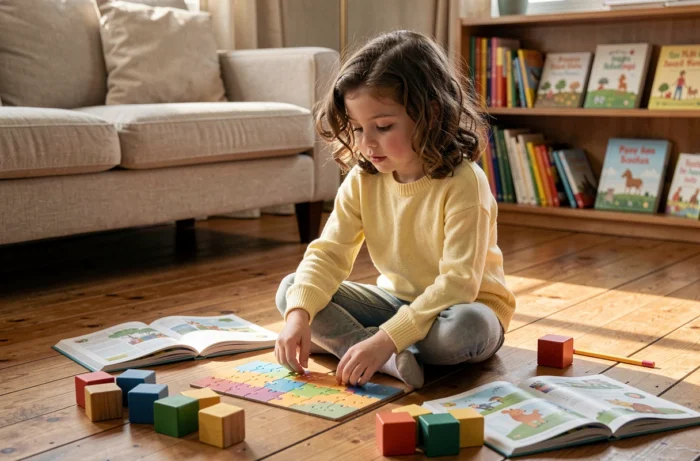
A child who refuses to eat their vegetables at the table, another who cries because they can’t tie their shoes: these everyday scenes reflect very different needs. Identifying the relevant category of need allows for a more accurate response, rather than applying the same educational strategy to everything. Understanding the different categories related to your child’s development provides a framework for adapting your support to each situation.
Coordination among adults: the often-overlooked lever of child development
Have you noticed that a child reacts differently depending on whether both parents are on the same page or contradict each other? This phenomenon has a name: coparenting. It refers to how the adults raising a child coordinate with each other.
A study published in 2026 shows that a prenatal coparenting facilitation program improves parental role adjustment, reduces parental stress, and alleviates depressive mood. Coordination among adults acts even before the child is born.
In practical terms, this means that before choosing an educational method, it’s best to ensure that the adults in the household share the same references. A child quickly picks up on inconsistencies. If one parent allows screen time after dinner while the other forbids it, the child retains neither the rule nor the reason: they retain the ambiguity.
To explore in detail the themes that affect families’ daily lives, the categories on Mon Enfant Un! group resources categorized by age and need.
Categories of child development: motor, cognitive, emotional, social
When we talk about categories for development, we are not referring to rigid boxes. We are talking about four main axes of development that early childhood professionals use daily, particularly in daycare and childcare settings.

Motor development
This is the most visible. Crawling, walking, running, catching an object. A child who masters their body gains independence and confidence. Free activities (climbing on an obstacle course, manipulating play dough) stimulate this category much better than directed exercises.
Cognitive development
Learning to sort shapes, understanding instructions, memorizing a nursery rhyme. Cognitive development thrives on repetition and curiosity. Exploration games, age-appropriate puzzles, and shared reading moments are the best tools for this.
Emotional development
Naming what they feel, accepting frustration, expressing joy. This is the category where parents intervene the most, sometimes unknowingly. A child who can name their emotions manages them better than a child who is told to calm down without explanation.
Social development
Sharing a toy, waiting their turn, saying hello. Social skills are learned through imitation and group living, whether in daycare, at school, or during collective activities. A typical day for a child in a group setting is a constant training ground for this category.
Activities and games adapted by age group
Knowing which category a need falls into is not enough. It’s also essential to choose the right activities at the right time. A game that is too simple is boring, while a game that is too complex is discouraging.
- Before 18 months: sensory games (textures, sounds, water) stimulate both motor and cognitive development simultaneously. Baby products like textured play mats fulfill this role well.
- Between 18 months and 3 years: imitation games (play kitchen, workbench, dolls) develop social and emotional skills. The child reproduces life scenes and learns relational codes.
- Between 3 and 6 years: simple rule games (board games, guided activities) strengthen cognitive and social skills. This is also the age when free drawing becomes a tool for emotional expression.
Adapting play to the child’s age respects their developmental pace. Early childhood professionals in micro-crèches, for example, organize the day around activity slots designed by age group.

Authoritative parenting style: why research distinguishes it from others
There are several parenting styles described in research. The authoritative style combines clear expectations with genuine listening to the child. Recent research confirms that this style is the most effective for supporting development, but it nuances its effects: the impact on academic outcomes remains modest compared to the impact on self-confidence.
The authoritative style works because it simultaneously addresses several categories of development. By setting a framework (cognitive and social), explaining the reasons behind a rule (cognitive and emotional), and allowing the child to express their disagreement (emotional and social), the parent activates four levers in a single interaction.
In contrast, a purely permissive style stimulates short-term emotional well-being but undermines social development. A purely authoritarian style structures the framework but may hinder emotional expression.
Parental mindfulness: what research nuances
Mindfulness interventions aimed at parents are gaining increasing popularity. Recent literature tempers the promises: the clearest effect concerns the reduction of parental stress, not the overall well-being of the child.
This does not disqualify the approach. A less stressed parent communicates better, reacts more measuredly, and offers a more stable framework. The effect on the child is indirect but real. The nuance matters for parents hoping for quick visible results: mindfulness first affects the parent, and indirectly the quality of the relationship.
- What works: practicing a few minutes of conscious breathing before a predictable tense moment (bathing, bedtime).
- What works less: imposing long sessions on a parent already exhausted by their day.
- What helps concretely: identifying which category of need the current difficulty falls into, then adapting the response rather than reacting reflexively.
The flourishing of a child is not limited to a single method or a list of rules. It relies on parents’ ability to identify the right developmental axis at the right time and adjust their approach accordingly. The best tool remains careful observation of your child, day after day.