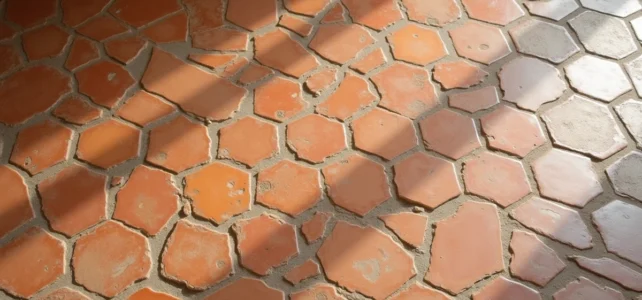
Old terracotta tiles impose their constraints on any covering laid nearby. Their irregular thickness, porosity, and color that varies from one tile to another depending on the original firing: these technical parameters condition the choice of complementary tiling much more than purely aesthetic considerations. Combining modern tiling with old tiles without causing disorders (detachment, rising humidity, visual break) requires an understanding of the physical behavior of these floors.
Breathability of the old floor: the technical criterion that decor does not show
Terracotta tiles function as a vapor-permeable material. In old buildings, this breathability capacity continuously regulates the humidity of the floor. Laying complementary tiling with an adhesive or leveling compound that is completely waterproof next to terracotta tiles effectively blocks these hygrometric exchanges over part of the surface.
The consequences are documented by professionals in sanding and renovation: efflorescence appearing at the joints, tiles sounding hollow after a few months, gradual detachment. The problem does not come from the tiling itself, but from the chosen installation system.
To preserve this balance, specialized companies recommend avoiding film-forming leveling compounds under the adjacent tiling and favoring lime-based mortars and adhesives that are compatible with old substrates. A tiling guide on La Maison Info details possible associations while taking these installation constraints into account.
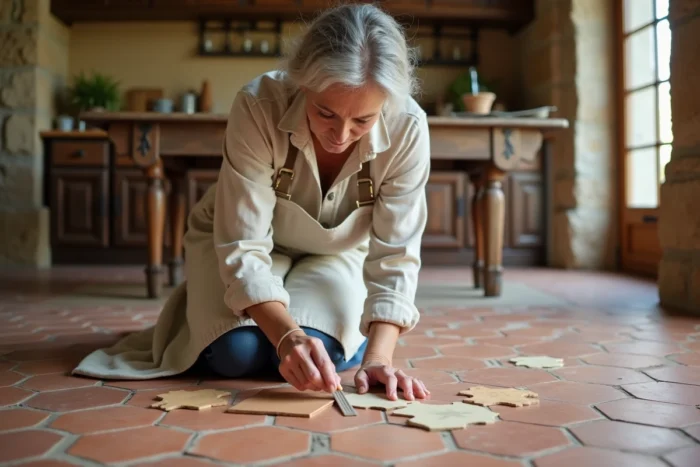
Tiling compatible with old terracotta tiles: thickness, format, and joints
The thickness of old terracotta tiles varies depending on their origin and manufacturing period. This irregularity creates a level discrepancy with most standard modern tiles. Compensating for this difference with a thick leveling compound raises the breathability issue mentioned earlier.
Two technical approaches coexist on site:
- Choosing a tile with a thickness similar to the existing tiles, which limits the need for leveling and preserves the continuity of the floor. Full-body porcelain tiles are available in various thicknesses suitable for this scenario.
- Opting for a tile with a terracotta appearance, whose color and texture resemble the patina of the tiles, reducing visual contrast even if the materials differ.
- Working the joints as a transitional element: a soft expansion joint between the two coverings absorbs differences in expansion and visually marks the boundary between old and new without masking it.
The trap of the systematic hexagonal format
Reproducing the hexagonal format of the tiles with modern tiling often creates a pastiche effect. Field reports diverge on this point: some tilers believe that mixing two hexagons of different materials muddles the reading of the floor. Others consider that the material contrast between terracotta and porcelain enhances the original tiles, provided the shades are varied.
A rectangular or square format laid in opposition to the hexagonal tiles often works better, as it emphasizes the distinction between the two areas without attempting to imitate the old.
Terracotta tiles and low-temperature underfloor heating: real compatibility
In energy renovation projects, the question of underfloor heating arises systematically. Old terracotta tiles handle low-temperature underfloor heating well, and the tiling laid next to it can also function on this system, under two specific conditions.
The first concerns the adhesive: a flexible adhesive rated C2S1 or C2S2 absorbs the expansions related to heating cycles. A standard rigid adhesive cracks under the effect of repeated thermal variations, especially at the junction between two materials with different expansion coefficients.
The second pertains to the screed. Professionals recommend an anhydrite screed rather than cement for heated floors, as it offers better thermal conductivity and a more regular flatness, which facilitates managing the level discrepancy between the terracotta tiles and the new tiling.
Patina and surface treatment: harmonizing the old and the new
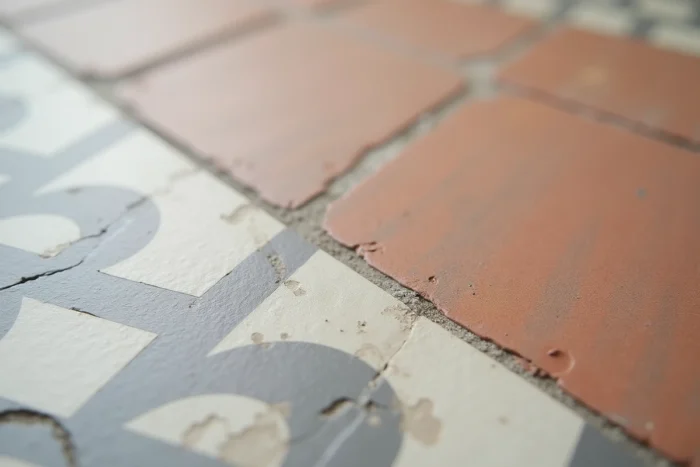
Laying brand new tiling next to terracotta tiles that have been patinated by decades of use creates a sometimes harsh surface contrast. The current trend among renovation professionals is to treat the existing tiles with natural products (linseed oil, black soap) rather than with film-forming varnishes, even when modern tiling is added nearby.
The goal: to maintain a coherent patina between old and new without creating a “plasticized floor” effect on the tiles. Thick varnishes alter the touch and shine of the terracotta, which accentuates the break with the adjacent tiling.
Dosage and drying time: two underestimated variables
Improperly dosed linseed oil makes the floor sticky, a recurring problem reported by craftsmen. The drying times between layers condition the final result. Applying a second layer before the first is fully absorbed traps excess on the surface and produces exactly the opposite effect of what is sought.
The complementary tiling generally does not require specific treatment. Porcelain tiles are naturally stain-resistant. However, if the choice is made for new terracotta tiling to stay within the same family of materials, the same treatment protocol applies, with the same dosage requirements.
Wet areas: three criteria to cross for associating terracotta tiles and tiling
In bathrooms and kitchens, the juxtaposition of terracotta and tiling adds an additional constraint: resistance to water and slipping. Specialized tilers recommend crossing three specific criteria:
- The anti-slip classification of the chosen tiling (R rating), which must be consistent with that of the adjacent tile to avoid a slippery area right next to an adhering area.
- The water absorption of the chosen tiling, ideally low (porcelain) in areas of direct projection, even if the adjacent terracotta tiles are more absorbent.
- The water-repellent treatment of the tiles themselves, which must be renewed regularly in damp areas without obstructing the natural porosity of the material.
The choice of tiling in these areas is not just a matter of color or style. The junction between two materials with different water behaviors remains the weak point of these associations, and it is on this technical detail that successful projects stand out from renovations that need to be redone.