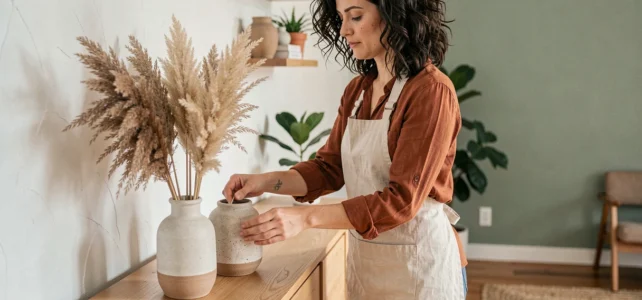
Transforming an interior is not just about changing the wall color or buying a new sofa. It involves working with volumes, materials, and light—three levers that, when combined, alter the perception of a room without necessarily requiring heavy renovations. A well-thought-out space is based on concrete, measurable choices, rather than a mere accumulation of decorative objects.
Natural materials and textures: the foundation of original decor
Before choosing a style or color palette, the question of materials comes to the forefront. The texture of a covering or textile directly influences the atmosphere of a room, much more than a simple color choice.
Raw wood, thick linen, terracotta, or reconstituted stone provide a visual density that smooth, uniform surfaces do not create. A lime plaster wall, for example, captures light differently depending on the time of day, creating a depth that standard matte paint cannot replicate.
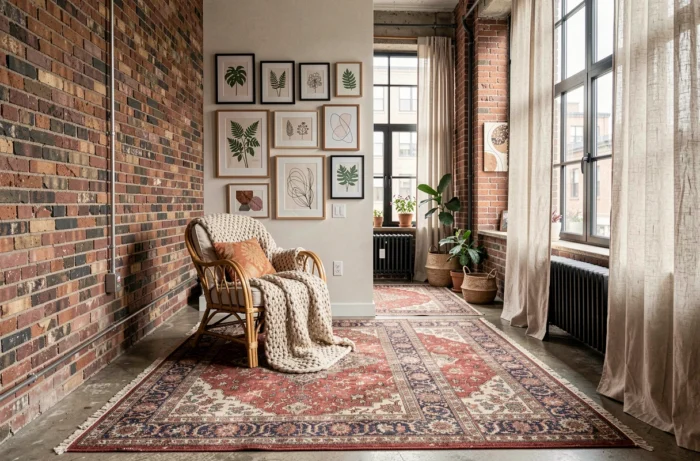
Current trends in interior design confirm this shift towards organic shapes and natural materials. The principle is simple: vary the textures within the same space to avoid a catalog effect. A corduroy sofa placed on a jute rug, in front of a brick wall, creates a tactile contrast that draws attention without resorting to bright colors.
To delve deeper into this layering logic, Votre Déco’s decor tips detail material combinations suitable for each type of room.
Mixing old and modern in your living room or common area
One of the most common reflexes in decoration is to buy all the furniture from the same collection, or even from the same manufacturer. The result is coherent but often impersonal. Pairing a vintage piece with contemporary furniture creates a more authentic decor that is harder to replicate.
A vintage armchair from the 1960s, reupholstered in a current fabric, can become the focal point of a living room entirely furnished in Scandinavian design. The key lies in choosing a common element that connects the eras: a wood tone, a metal (brass, copper), or a rounded shape repeated across several objects.
Designers interviewed by the specialized press recommend starting from personal memories or found pieces to build a decor that tells a story. An object brought back from a trip, an old family frame, or a handmade lamp is enough to anchor a room in its own identity, far from standardized interiors.
Identifying elements to keep rather than replace
Before any purchase, a quick inventory of what you already own helps avoid unnecessary expenses. A piece of furniture in good condition, repainted or simply moved to another room, can radically change the dynamics of a space.
- The dining room sideboard, repositioned in the entryway, creates functional storage and a visual focal point right at the threshold.
- A solid wood coffee table, sanded and covered with a matte varnish, regains a contemporary look without losing its character.
- The mismatched chairs, unified by the same paint color, form a coherent and original set around a dining table.
Wall art and decorative objects: creating focal points in every room
A blank wall is not a sober wall; it is an unfinished wall. Wall decoration plays a structuring role in the perception of a space. A large painting, a composition of frames, or a wallpaper panel on a single wall is enough to redefine the visual proportions of a room.
The choice of pattern is as important as the size. Geometric patterns visually enlarge a narrow space when arranged in vertical lines. Floral or botanical patterns, on the other hand, soften a living room with very linear furniture.
Composing a gallery wall without falling into clutter
Creating a gallery wall follows a few technical rules that avoid a hodgepodge effect:
- Start by laying all the frames on the floor to test the arrangement before drilling.
- Maintain a regular spacing (the width of a hand) between each frame for a fluid reading.
- Mix formats (a large frame surrounded by smaller ones) while keeping a central axis aligned.
- Limit the color palette of the frames to two or three tones to unify the whole.
This approach transforms a simple hallway or living room wall into a personal gallery, with a limited investment.
Light and sculptural shapes: the details that change the atmosphere
Lighting is the most underestimated lever in interior decoration. A room can contain the most refined furniture in the world: under flat and uniform lighting, it will appear dull. The multiplication of light sources (table lamps, pendants, wall sconces, garlands) creates areas of shadow and light that literally sculpt the space.
Sculptural shapes in lighting fixtures are a strong trend in interior design. A woven rattan pendant, a lamp with curved lines, or a Japanese paper lampshade become decorative objects in their own right, even when turned off.
Soft light, achieved through warm temperature bulbs and diffusing material lampshades, fosters a holistic sensory experience in the room. It is no longer just a matter of aesthetics: the type of light influences the comfort felt in daily life.
Craftsmanship and unique pieces rather than mass production
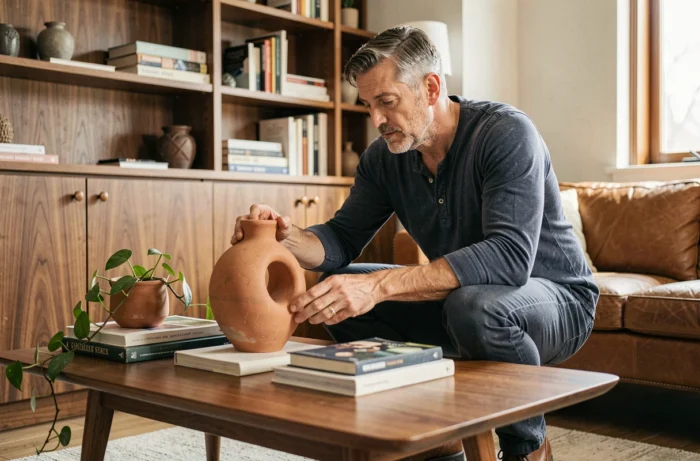
Sustainable craftsmanship is gaining ground in decoration choices. Choosing a handmade object (ceramic vase, forged metal candlestick, artisan-framed mirror) brings a surface irregularity and uniqueness that industrial production cannot offer.
This choice is not necessarily more expensive. Designer markets, local artisan sales platforms, and flea markets allow you to find unique pieces at prices comparable to those of entry-level furniture.
Each artisanal object introduced into an interior adds a layer of character. Three handmade pieces are enough to distinguish a living room from a showroom, provided they are spread throughout the space rather than concentrated on a single shelf.