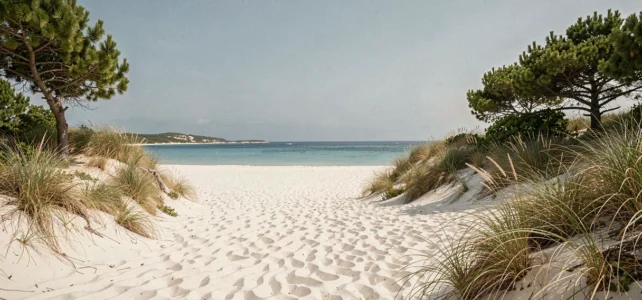
On the island of Ré, naturism is not practiced randomly. The sections of beach where one can lay their towel without a swimsuit are defined by municipal decree, marked by signs at the beginning and end of the area, and their use varies by municipality. Understanding this regulatory mosaic allows one to distinguish the areas that are truly tolerated from the beaches where the practice remains prohibited, and to identify the least crowded sectors.
Beach Supervision and Naturism on the Island of Ré: Two Distinct Logics
The confusion between naturist beach and supervised beach often arises. On the island of Ré, supervision only applies in July and August, generally from 11 a.m. to 7 p.m. depending on the sector. The tolerated naturist zones, on the other hand, do not have any specific supervision.
This discrepancy has a direct practical consequence: on a naturist beach, swimming is the individual’s responsibility all year round. The Grenettes beach, for example, is announced as unsupervised during the summer season, which clearly distinguishes it from a classic bathing beach like Montamer, which is among the supervised beaches.
| Criteria | Tolerated Naturist Beach | Classic Supervised Beach |
|---|---|---|
| Supervision in Summer | None | July-August, 11 a.m. – 7 p.m. |
| Signage | Municipal decree signs | Swimming flags |
| Nearby Shops | None on site | Variable by location |
| Access | Dune paths, often remote | Developed access points |
Anyone planning a naturist outing on the island must take this into account: bringing water and sunscreen is a necessity, not just a comfort suggestion. The isolation of these beach sections adds to their charm but also to their demands. To precisely locate the relevant sectors, a map of naturist beaches on the island of Ré allows one to visualize the tolerated areas before heading out.

Municipal Decrees and Zoning: What Naturist Regulations Really Impose
Competitors list beaches. They rarely mention the legal mechanics that make them accessible for naturism. On the island of Ré, each municipality defines its own zones by municipal decree. The perimeters, periods, and sometimes hours can vary from one municipality to another.
Naturism is tolerated in four identified sectors. The beach of Peu Bernard, straddling La Couarde-sur-Mer and Le Bois-Plage-en-Ré, around the Pas de la Batterie, is the most documented sector. A sector also exists between Saint-Clément-des-Baleines and Les Portes-en-Ré.
In contrast, the practice remains strictly prohibited on the beaches of Sainte-Marie-de-Ré, Saint-Martin-de-Ré, La Flotte, Ars-en-Ré, and Loix. The signage by panels marks the exact limits of each tolerated zone. Exceeding these limits, even by a few meters, exposes one to fines.
Municipal Granularity and Traps to Avoid
The most common trap is to rely on online lists that name an entire beach when only a portion is concerned. The Conche des Baleines, for example, is a long beach of which only a section allows the practice. Setting up in the wrong place amounts to violating the decree, even in good faith.
- Identify the entrance and exit signs of the zone before settling in, even when the beach seems deserted
- Check if the municipal decree specifies specific hours or periods, as some sectors are only tolerated in season
- Do not rely on observed practices on site: the presence of other naturists outside the marked zone does not make the practice legal
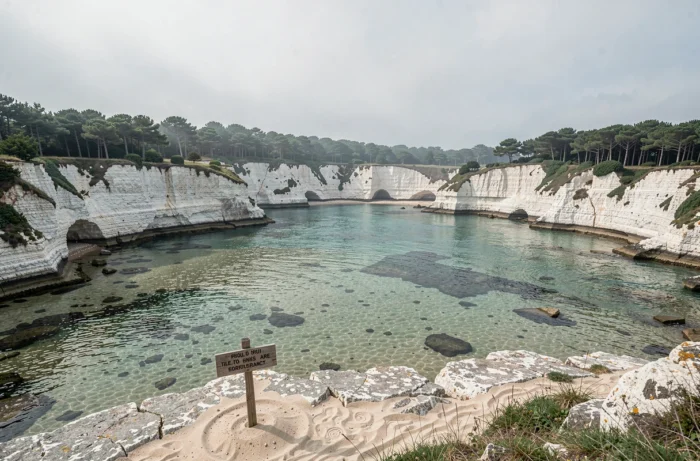
Less Crowded Naturist Beaches on the Island of Ré: Sectors to Identify
The appeal of “secret beaches” relies less on a geographical secret than on accessibility. The most isolated naturist sections require a walk of several minutes through dune paths, with no direct car access.
The sector between Saint-Clément-des-Baleines and Les Portes-en-Ré combines this access difficulty with a wild coastline, bordered by preserved dunes. The absence of shops and immediate parking naturally filters the attendance. In mid-summer, these sections remain significantly less crowded than the supervised beaches in the south of the island.
Peu Bernard and Pas de la Batterie: The Central Sector
The Peu Bernard area, between La Couarde-sur-Mer and Le Bois-Plage-en-Ré, is the best-known among regular naturists. Its attendance is therefore higher in peak season. For those seeking tranquility, the ends of the marked area offer more space, provided one stays within the indicated limits.
The sand is fine, and the coastline is exposed directly west facing the Atlantic Ocean. The currents can be strong, and the lack of supervision requires increased vigilance for swimming.
Naturism and Dune Environment on the Island of Ré: A Regulated Coexistence
Naturist zones are almost all located in fragile dune sectors. The marked paths are not decorative: trampling them destroys an ecosystem that protects the coastline from erosion. The municipal decrees actually incorporate this environmental dimension into their provisions.
The island of Ré has classified a large part of its northern coastline as a natural area. Salt marshes, fishing villages, and lighthouses punctuate a landscape where naturism is part of a logic of discretion and respect for the site. Accessing a naturist beach via dune paths is also to traverse a natural heritage that overuse threatens every summer.
- Stay on marked paths to access the beaches, even if a shortcut through the dunes seems obvious
- Take all your waste with you: no bins are installed on the isolated naturist sections
- Avoid setting up umbrellas or stakes in dune vegetation areas

The naturist beaches of the island of Ré are neither hidden nor secret in the strict sense. They are regulated, marked, and their access simply requires reading a municipal decree and walking a bit. The difference between a successful outing and a fine often hinges on spotting a sign, or not, at the end of a dune path.