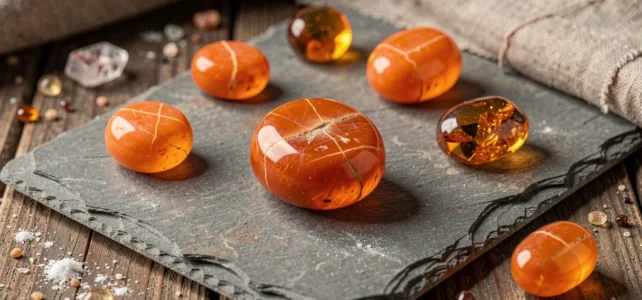
The orange stones encompass a family of minerals whose shades, ranging from bright mandarin to deep copper, come from specific chemical elements: iron for carnelian, manganese for spessartite garnet, and organic inclusions for amber. Their color connects them in lithotherapy to the sacral chakra, an energy center located below the navel, associated with vitality, creativity, and emotional balance.
Why the orange color varies so much from stone to stone
The orange hue of a mineral depends on its chemical composition and mode of formation. Carnelian, a variety of chalcedony, derives its orange from trivalent iron dispersed in silica.
Amber, a fossilized resin rather than a crystal in the strict sense, presents honey to dark orange tones depending on the plant inclusions it has trapped over time. Orange calcite, on the other hand, displays a uniform hue linked to calcium and traces of iron.
This diversity of mechanisms explains why two orange stones placed side by side can have radically different lusters, transparencies, and densities. A fire opal, translucent and fragile, is nothing like an orange jasper, opaque and robust.
Understanding the origin of color helps anticipate the durability and maintenance of each stone. To learn more about Bin News, the topic is approached from the perspective of the natural symbolism related to these minerals.
Choosing an orange stone according to a specific need
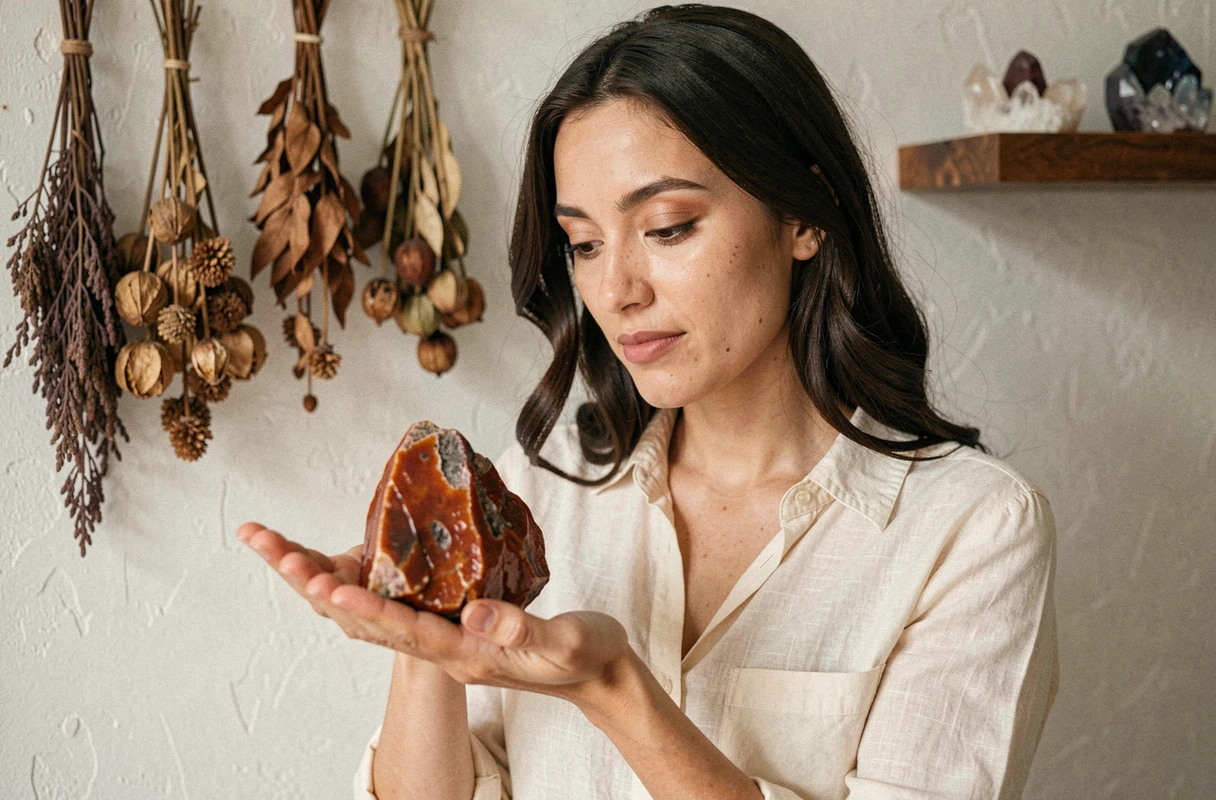
Recent content in lithotherapy now distinguishes families of use among orange stones, rather than attributing a unique power to them. Three main orientations emerge.
Energy and motivation in daily life
Carnelian is the reference for those seeking a boost of dynamism. In lithotherapy, it is associated with courage, motivation, and creativity. Orange calcite serves a similar role, often described as a stone of enthusiasm and self-confidence.
These two minerals are worn as bracelets or pendants close to the body, which, according to practitioners, promotes prolonged contact with the skin.
Grounding and emotional stability
Orange aragonite and amber are more oriented towards grounding. Aragonite is considered a useful grounding stone for regaining inner calm. Amber, due to its warmth to the touch and organic origin, is traditionally linked to protection and soothing.
If the focus is on emotional re-centering rather than an energetic boost, these two stones are a more coherent choice than carnelian.
Prosperity and abundance
Orange citrine holds a special place. Often called the “merchant’s stone,” it has been associated for centuries with material prosperity and optimism. Its hue, ranging from golden yellow to warm orange, places it on the border between yellow and orange stones.
- Carnelian and orange calcite: energy, creativity, dynamism. Worn on the wrist or kept in a pocket, they are suitable for periods of fatigue or lack of drive.
- Aragonite and amber: grounding, calm, stability. Preferred during phases of stress or personal transition.
- Citrine: prosperity, mental clarity, optimism. Traditionally placed in a workspace or worn as a ring.
Symbolism of orange stones according to cultures
The color orange does not carry the same symbolic weight everywhere. In Hindu tradition, orange is the color of renunciation and spiritual quest, worn by sadhu monks. Orange stones are considered as supports for meditation.
In the West, orange evokes warmth, joy, and vitality, which explains the frequent association of these stones with well-being and positive energy. In pure gemology, the orange color sometimes increases the rarity and market value of a gem: a padparadscha sapphire (pink-orange) or a beautifully saturated spessartite garnet are among the most sought-after stones by collectors.
The symbolism of the sacral chakra traverses these different traditions. This second chakra, called Svadhisthana in Sanskrit, is linked to emotions, sensuality, and creativity. Orange stones are placed on this area during meditation or energy healing sessions.
Maintenance and precautions to preserve orange stones
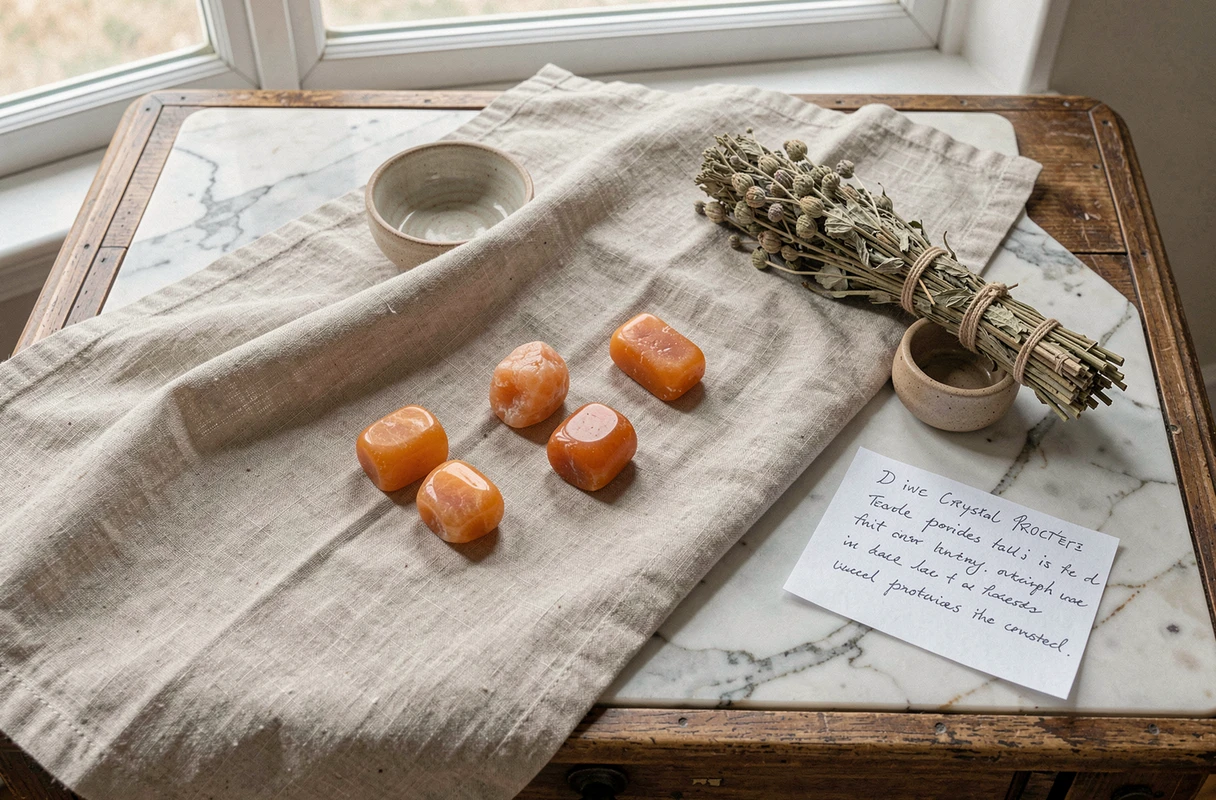
A often overlooked point concerns the variable fragility of these minerals. Fire opal, for example, is sensitive to thermal shocks and dehydration. A spessartite garnet withstands daily handling better due to its higher hardness.
Avoiding prolonged sunlight is a valid precaution for most orange stones. Carnelian and amber can tarnish or crack after intense UV exposure. Recent recommendations suggest recharging in the soft morning light rather than in direct midday sun.
For purification, clear water is suitable for carnelian and garnet, but not for orange calcite (soluble) or amber (sensitive to chemicals). Checking the compatibility of each stone with the chosen cleaning method remains the most useful reflex before any handling.
Lithotherapy increasingly specifies that no measurable energy has been scientifically demonstrated for these minerals. The effect reported by users comes through intention, ritual, and regular physical contact with the stone. Keeping this nuance in mind allows for approaching orange stones with curiosity, without disproportionate expectations.