
The French driving license in the pink paper format remains a legally valid driving document on national territory. However, when it comes to crossing a border, the question of its recognition abroad is more nuanced than one might think.
Pink license and vehicle rental abroad: the distinction that traps travelers
A point rarely addressed in travel guides concerns the difference between a driving document and an identity document. The pink cardboard license, even if valid, is not recognized as an identity document by several European states. This distinction has very concrete consequences.
When renting a vehicle outside France, agencies systematically require a driving license and a separate identity document (passport or national identity card). Presenting only the pink license as proof can lead to a refusal to provide the vehicle, even if your right to drive is not questioned.
The European directive of October 2025 reinforces this trend. Countries that used the license as an identity document can now limit its validity to ten years instead of fifteen. The question of the validity of the pink license outside France therefore goes beyond the simple right to drive: it also touches on the practical acceptance of the document by local professionals.

Valid French license in Europe: what the legal framework says
The French driving license, regardless of its format, is sufficient to drive throughout the European Economic Area. This includes EU countries as well as Iceland, Liechtenstein, and Norway. No international license is required in this area.
The framework is based on mutual recognition among member states. A license issued by France is accepted as is in Germany, Spain, Italy, or any other EEA country. The format (pink cardboard or plastic card) does not change this legal recognition.
However, some local control agents do not recognize the three-fold paper format. Field reports vary on this point: some drivers report smooth checks in Greece or Portugal, while others describe temporary blockages in Eastern Europe as the agent verifies the validity of the document.
Particular case of drivers under 18
Since January 1, 2024, a French person can drive alone at 17 years old on national territory. This rule does not export. Directive 2006/126/EC sets 18 years as the minimum age for recognition of category B in other EU countries. A 17-year-old French driver, whether holding a pink license or a new format license, cannot legally drive in almost all European countries.
International license and countries outside Europe: when the pink license is no longer enough
Outside the EEA, the rules vary significantly from country to country. The French license may suffice for a short stay in certain states, but an international license is often required in addition.
The international license is not an autonomous document. It functions as an official translation of the national license and must always be presented together with the original French license. Its issuance is based on the United Nations conventions on road traffic, signed in Geneva in 1949 and Vienna in 1968.
Before applying for an international license, it is essential to check if the destination country actually requires it. French authorities recommend consulting the website of the relevant embassy. Some countries accept the French license alone for a limited time, while others require an international license upon entry into the territory.
- The international license is free and can be requested online via the ANTS website before departure.
- It never replaces the national license: both documents must be presented together during a check.
- Its validity period and acceptance conditions depend on bilateral agreements between France and the visited country.
French expatriates and pink license exchange: the constraint of normal residence
For French citizens permanently established abroad, the situation of the pink license raises specific questions. International conventions set a clear principle: anyone who has established their normal residence in a state must hold a license issued by that state.
French law defines normal residence as a minimum of 185 days per year in the territory, due to personal and professional ties. An expatriate who no longer meets this criterion is theoretically required to exchange their French license for a local license, according to the rules of the host country.
The scheduled disappearance of the pink license on January 19, 2033 adds a timing constraint. Expatriates who do not have access to French online procedures (the replacement goes through the ANTS website) may find themselves in a complex administrative situation. A parliamentary question posed by Senator Sophie Briante Guillemont recently clarified the government’s position on the leeway for these profiles.
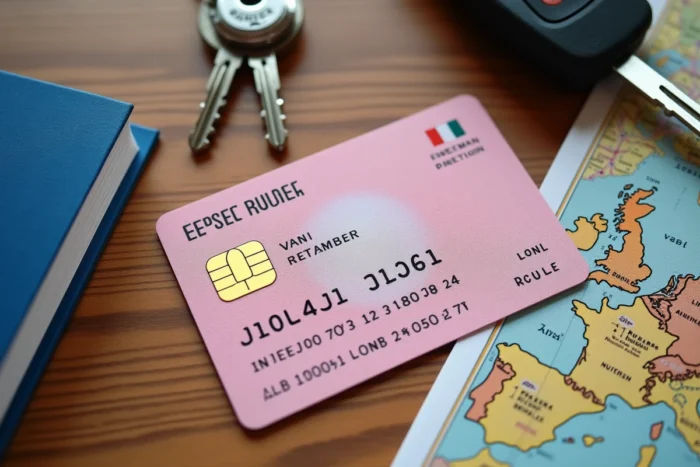
What to do before traveling
- Check that the pink license is in good condition and legible: a damaged document may be considered invalid during a check abroad.
- Always carry a separate identity document (national identity card or passport) in addition to the license.
- Consult the website of the embassy of the destination country to know the local requirements regarding the international license.
- Anticipate replacing the pink license with the new card format if a trip outside the EEA is planned, to limit the risks of non-recognition of the paper document.
The pink license remains a valid driving document, including abroad, until 2033. The difficulty does not come from the law but from practice: a cardboard document several decades old raises suspicion among control agents and rental companies in many countries. Anticipating the transition to the card format before an international trip remains the most reliable precaution.